Food Guide
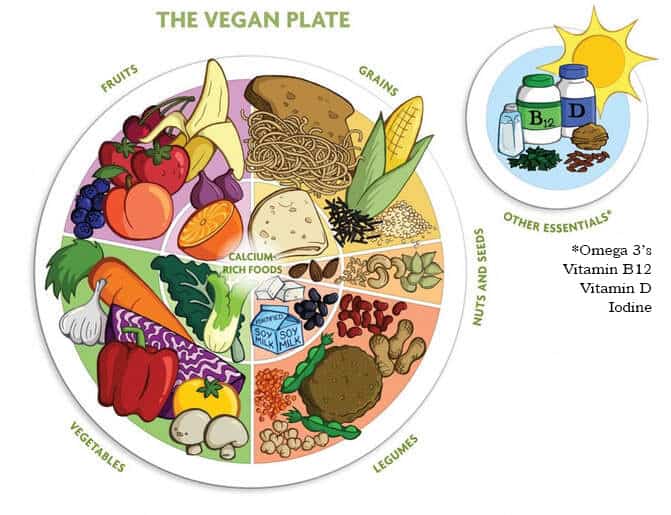
The Vegan Plate
Graphic from “Becoming Vegan: Comprehensive Edition” and “Plant Powered Protein” (Davis, Melina & Davis), Book Publishing Co.
Here is a plan for healthful eating, designed to keep you in optimal health.
Vegetables, shown to take up just over one-quarter of your plate in the diagram, should come from the listings in the green-shaded area below.
Legumes, shown to take up another quarter of your plate, should come from the blue-shaded area, and so on.
| Food group and servings per day | Foods in this group with serving size | Calcium-rich foods with serving size | Notes |
|---|---|---|---|
|
Vegetables:
5 or more servings |
1⁄2 cup (125 ml) raw or cooked vegetables
1 cup (250 ml) raw leafy vegetables 1⁄2 cup (125 ml) vegetable juice |
1 cup (250 ml) cooked bok choy broccoli, collard greens, kale, mustard greens, napa cabbage, or okra
2 cups (500 ml) raw bok choy, broccoli. collard greens, kale, or napa cabbage 1⁄2 cup (125 ml) calcium-fortified tomato or vegetable juice |
Include at least 2 daily servings of calcium-rich greens. Choose from the full rainbow of colorful vegetables: purple, blue, green, yellow, orange, red, and white. |
|
Fruits:
4 or more servings |
1 medium fruit 1⁄2 cup (125 ml) fruit or fruit juice 1⁄4 cup (60 ml) dried fruit |
1⁄2 cup (125 ml) calcium-fortified fruit juice
1⁄4 cup (60 ml) dried figs 2 oranges |
Fruits are excellent sources of potassium. Enjoy the full spectrum of colorful fruits, and make them your sweet treats. |
|
Legumes. 3 or more servings |
1⁄2 cup (125 m mi) cooked beans, peas, lentils, tofu, lentils, tofu,
or tempeh
1 cup (250 ml) raw peas or sprouted lentils or peas 1⁄4 cup (60 ml) peanuts 2 tablespoons (30 ml) peanut butter 1 serving vegan meat alternative |
1 cup (250 ml) black or white beans 1⁄2 cup (125 ml) fortified soy milk or soy yogurt 1⁄2 cup (125 ml) calcium-set tofu (look for calcium on the ingredient list), cooked soybeans, or soy nuts |
Legumes are great sources of protein, iron, and zinc with an average of 7 to 9 grams of protein per serving. Include a selection from this group at most meals. |
|
Grains: 3 or more servings |
1⁄2 cup (125 ml) cooked cereal, pasta, quinoa, rice, or other grain 1 ounce (28 g) bread 1⁄2 cup (125 ml) raw corn or sprouted quinoa, buckwheat, or other grain 1 ounce (28 g) cold cereal |
1 serving calcium-fortified breakfast cereal
1 calcium-fortified tortilla 1/2 cup calcium-fortiifed oat milk |
Select whole grains as often as possible. Adjust the number of grain servings to suit your energy needs; some need many more servings. Those wanting to lose weight may need less. Some fortified cereals and tortillas are particularly high in calcium. |
|
Nuts and
seeds:
1 or more servings |
14 cup (60 ml) nuts or seeds
2 tablespoons (30 ml) nut or seed butter |
1⁄4 cup (60 ml) almonds
2 tablespoon (30 ml) almond butter or sesame tahini |
Seeds and nuts contribute copper, selenium, other minerals, vitamin E and fat. Choose some that are rich in omega-3s. |
Other Essentials
Here are recommendations on a few essential nutrients of interest to vegans:
Omega-3 fatty acids, Vitamins B12, D and Iodine.
Click on individual topic below for details:
Omega-3 fatty acids. Include at least one of the following:
- 2 tablespoons (30 ml) of ground flaxseeds or chia seeds
- ¼ cup (60 ml) of hempseeds
- ⅓ cup (85 ml) of walnuts
- 1½ teaspoons (7 ml) of flaxseed oil
- 1½ tablespoons (22 ml) of hempseed oil
Taking a supplement of 500 to 1000 mg of algae-based DHA plus EPA several times per week or daily can be beneficial for many individuals and especially during pregnancy or for those with diabetes).
Vitamin B12. Include one of the following:
- A daily supplement that provides at least 50 mcg of vitamin B12
- Ages 65+ or taking metformin – take a daily supplement providing 500-1000 mcg of vitamin B12.
- Twice a week, a supplement that provides at least 1,000 mcg of vitamin B12
- Three servings daily of foods fortified with vitamin B12, such as nondairy milks, vegan meats, or breakfast cereals, totaling 4 mcg of vitamin B12 for the day (100 percent of the daily value). For one of those servings, you can use 2 teaspoons (10 ml) of Red Star Vegetarian Support Formula nutritional yeast flakes.
Get vitamin D in the following ways:
- Expose your face and forearms to warm sunlight (between 10 a.m. and 2 p.m., without sunscreen) day, for fifteen minutes if you have light-colored skin, twenty minutes if you’re dark-skinned, and thirty minutes if you’re a senior. It is important to avoid excessive exposure to ultraviolet light.
- If you can’t get enough sun exposure, for instance, during winter, especially in northern latitudes, take a supplement or eat fortified foods. The recommended daily vitamin D intake for adults is 600 IU (15 mcg) to age seventy and 800 IU (20 mcg) after seventy. Significantly more is often needed to meet all needs for vitamin D and to bring serum vitamin D to optimal levels. Amounts of vitamin D as high as 1,000 to 4,000 IU (25 to 200 mcg) are considered safe.
Iodine. Include one of the following:
- A multivitamin-mineral supplement that provides 150 mcg of iodine
- About ⅜ teaspoon (2 ml) of iodized salt. Note that sea salt generally isn’t iodized; if it is, this will be declared on the label.
- Sea vegetables, such as kelp, also contain iodine, though the amounts can vary greatly and even reach toxic levels. Read product labels in case iodine is listed.
Practical Pointers
In addition to the preceding tips, a few simple dietary approaches will help ensure optimum nutrition and well-being:
Eat a wide variety of foods from each food group. Variety helps ensure you consume sufficient quantities of a broad range of nutrients, phytochemicals, and fiber. It also makes meals much more interesting.
Fill at least half of your plate with vegetables and fruits.
Be moderate in your intake of concentrated fats, oils, and added sugars. These foods are generally rich in calories but poor sources of nutrients. Excessive intakes of fat and sugar will crowd out foods that offer valuable nutrients. It’s better to use whole foods such as seeds, nuts, avocados, and olives as your sources of fat, and fruits as your source of sugar, rather than extracted oils and sugars.
Aim for an hour of physical activity each day. Activity is central to energy balance and overall health. It also helps maintains muscle strength, bone density, balance, and mental well-being.
Watch your sodium intake. Using ready-to-eat processed foods can make life easier, but relying excessively on canned, frozen, and other processed foods can result in excessively high sodium intakes.
Drink enough water to stay hydrated. Fluids such as water, herbal teas, and vegetable juices can help maintain good health and prevent kidney stones and urinary tract infections. Let thirst be your guide.
Book a Consultation
please fill out the form.