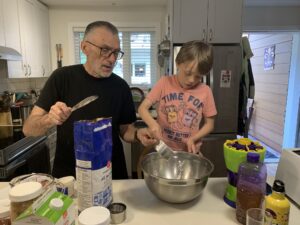
In this episode of Chef AJ Live, host Chef AJ sits down with Vesanto Melina, a plant-based registered dietitian, to discuss thriving on a low-fat, plant-forward lifestyle at age 81. They highlight the recently co-authored book Plant Powered Protein, with Brenda Davis and Brenda’s son Corey Davis, and preview Corey’s upcoming appearance on Plant Powered Protein.
Thriving at 81 on a Low-Fat Plant Based Diet
Chef AJ
It's really easy. Here we go. Hey, everyone, and welcome to Chef AJ Live. I'm your host, Chef AJ, and this is where I introduce you to amazing people like you who are doing great things in the world that I think you should know about. Well, happy Memorial Day, everyone. We've got two great shows for you today. And the first one is with Vesanto Melina, a plant-based registered dietitian, who will be talking about how she is thriving at 81 on a low fat, whole food diet, and she's authored, co-authored this wonderful new book with Brenda Davis and Brenda's son, Corey Davis, who will be guests on the show tomorrow called Plant Powered Protein. Please welcome Vesanto to the show.
Vesanto Melina
Oh, thanks, AJ. Such a pleasure.
Chef AJ
So nice to see you again. It's been a while.
Vesanto Melina
It has been a while, but boy, we've been part of this team and the world is shifting, isn't it? It really is. It's wonderful to see. Yeah, part of this team that is helping the world get more healthy, just environmentally friendly eating, lots of wonderful directions.
Chef AJ
That is wonderful. So tell us about the new book, Plant Powered Protein. Does it come out from the, you know, I've been vegan for almost 50 years, and I think the number one question most of us here is where are your protein?
Vesanto Melina
That's right. So we did this book because our publisher asked us to, and we said, we don't need a book on protein. It's easy to get protein on plant-based diets. And he said, well, that's what everybody asks. And we really need this, this kind of a book. And when we got into it, we actually found it was fascinating. There were all kinds of things to share, and certain age groups where we needed to be particular about it. For example, my senior age group, and so we really had a good time doing it. And then we brought in Corey Davis, our co-author for the first time, which is Brenda Davis's son, and he'll be talking in an upcoming zoom with you. But this is about the environment and that is drawing so many people, particularly young people, but all ages really to wanting to eat plant-based, because we realize how important it is.
Chef AJ
Absolutely. I look forward to meeting him tomorrow. I remember Brenda talking about him in a lecture once about when he was a little boy going to a birthday party at McDonald’s and finding out for the first time that hamburgers are made from cows.
Vesanto Melina
That's right, and he loved broccoli. He loved broccoli when he was a little kid. So he's been vegetarian his whole life and vegan for most of it and is wonderfully healthy. He works for the government as an environmentalist and agrologist. And so that was a great addition. So we'll see it a little bit from his chapter in this presentation.
Chef AJ
That is great. I mean, isn't it, you know, the true for your MSRD, registered dietitian and true protein deficiency, I believe is called kwashiorkor. Isn't it pretty, pretty rare, at least in the United States?
Vesanto Melina
It is, you know, but when I started, I started teaching university basically in 1965. at the University of British Columbia long time ago. And our perspectives then that it was that it was something to worry about. And it was really a concern for certain children in underdeveloped countries. But we found out later that it was often, they just didn't get enough food, wasn't necessarily the protein. So they were just short on many nutrients. And so that has certainly changed but my early perspective was that it was an important thing. So it's been interesting for me going as a dietitian for, I guess, 60 years now that I'd see this evolving perspective.
Chef AJ
Right, because, you know, I've heard from many of the plant-based doctors that it's pretty difficult to be protein deficient unless you're calorie deficient, you know, not eating enough.
Vesanto Melina
That's exactly right, yeah, yeah.
Chef AJ
It drives me crazy, Vesanto, when I go to, restaurants, and you know you'll order whatever you order. They go. Well, do you want any protein? I'm like it. you know, like, in other words. So if I order, you know I don't know a salad with beans or quinoa, or whatever you know that if I don't order, you know, cheese or egg or shrimp or chicken or fish, then I protein.
Vesanto Melina
That's true.
Chef AJ
It seems like they don't understand that plants have protein. Doesn't everything pretty much have protein? I mean, even fruit doesn't even have, not that we should eat fruit.
Vesanto Melina
Fruit has the less than 10% calories from protein. So, I'll actually have a slide on that. So we'll look at some slides in this presentation.
Chef AJ
Right, because what I'm trying to say is it's pretty rare to find a food that has no protein in it.
Vesanto Melina
That's right.
Chef AJ
You would actually have to work very hard.
Vesanto Melina
You would, except if you drink pop or potato chips. You know that kind of food. You have hardly any in potato chips, because potatoes have a bit of protein, but not much, and pop has zip. So, and those are big That's for many people in the United States. So. Oh, my gosh, I can't get.
Chef AJ
Said that because when I used to volunteer in a infusion center for people getting chemotherapy with my little therapy dog Bailey, when they would serve a lunch, they that would be part of the lunch was chips and pop.
Vesanto Melina
Wow.
Chef AJ
Yeah. Yeah, funny. Yeah, I that's crazy something. Did you want to? Did you want to start your presentation now?
Vesanto Melina
I'd love to. So I’ll share this screen with you. So this is all about plant-powered protein, this presentation, and many aspects of it. And these pictures are actually from our book. So we were. We were thrilled to have and not only all the nutrition and the environmental aspects, but also great recipes. And we have a number of recipe testers. It's kind of fun. So I'm kind of a simple recipe person. and Brenda and her son are more gourmet. They're more elegant. So we have a good balance of, you know, people wanting to keep it simple, and people wanting it also to be very attractive, and even it can go more gourmet. And then we have recipe testers. So we have five of them in British Columbia and one in San Francisco that just make sure that all our recipes are five star. So these are some of them. So and also websites like Nutrispeak, that's my website. But plant powered protein is the one for the book. So whoops. When we look at the questions that come up about plant protein. People really do wonder if vegans get enough protein, and there have been some very good studies on this. and We wonder if they're okay for every stage of life, like pregnancy. I have clients that come and they're just starting pregnancy, maybe a husband and wife or just the wife. But that's when people start really thinking about it. Gee, is it okay? You know, is my baby going to have every, every nutrient they need, including protein? And so this is when people worry about it and it's good to be really careful. So we've been very specific in this book about how to get about it at every stage of life. And then one of the early kind of myths really was that we had to carefully combine beans and grains. Do you remember Diet for Small Planet?
Chef AJ
Absolutely, Francis Moore Lepe.
Vesanto Melina
That's right. And you thought you had to have this much beans and this much green. So that was in the 70s. And by the 80s, Francis Moore Lepe said, whoops, we didn't need to do that. Don't worry about it. So what we say now is get a mix of foods, you know, different plant foods, and you'll be fine. You'll get enough of all the amino acids. And then this dietary choice affects our health. So I won't be talking so much about that. But Brenda Davis, dietitian who co-authored this book will be talking on that. in a meeting with you, and also about climate change. Her son, so this is neat having her son here. We'll talk about climate change and dietary choice. And then about athletes. Can they compete successfully? And of course, some athletes find they're even doing better than they did before they were vegan. And then seniors, how can they avoid sarcopenia or muscle loss, muscle wasting? So these are the kind of things we'll go over in this presentation. So our cultural bias is that people are always thinking protein, meat. Just jump there right away and ask if you're not, just like you found at the restaurant. Are you getting enough protein? But what we find is that there are all kinds of really big animals that have strong muscles, strong bones, all that. And the ones listed here, the rhinoceros, cow, elephant, moose, giraffe, bison, hippopotamus, horse, yak, they all eat a more plant-based diet, completely plant-based. and they have strong muscles, and so can we. So at the same time, you mentioned about kwashiorkor, in the early food guides, and of course, after the Depression, people were really concerned about malnutrition and hunger. I mean, people really hadn't had enough to eat in many cases during the Depression, and in different parts of the world, The calories were short and protein was short in some cases. And so the government policies were directed towards eliminating those possible problems. And people thought a chicken in every pot was really a good idea in the depression years. You know, it was just different perspective. And the education campaigns were dominated by eat more and protein was a big focus. So now, of course, what we're finding is that the problems are in the opposite direction, too much. So it's really different. But we did have food rules at a long time ago and food guides that were quite different in focus. So what we're thinking now is that it's time to really redefine our protein quality. We thought of meat as being a higher quality protein, but we're finding now these, what we thought of as higher quality are actually linked with higher rates of mortality and chronic disease. And the plant protein foods are linked with more favorable health outcomes. We have lower risk of all kinds of chronic diseases. And Brenda Davis is an expert in that area. And the high quality animal products are much more damaging environmentally. So the ways that we used to look at protein quality, these were funny, and I really remember these things happening, that how we judged protein was what was best to take a weanling rat who was four weeks old, so just weaned, to double its weight. And what we found was the best for that little rat, growing rat, was meat and cheese, which they loved. And that has been a really powerful sort of thought creator in regard to protein, and actually was the basis for many of our legal concepts. But rats are different from us in that they're fur bearing. And of course, not any humans that I've ever met want to double their weight in four weeks. So the whole thing is, is quite, you know, it's quite, quite different from what we have as human needs. And so this actually underestimates the value of plant protein foods. However, the protein efficiency ratio was adopted in Canada as the method for assessing protein quality and is still in place. And it was adopted in the US as an assessing tool for protein quality. Now, the US has shifted over just very recently to something called PDCAAS. which is the protein digestibility corrected amino acid score, big long phrase. But this, again, has some flaws. And we're really struggling, how do we assess which proteins are best? And I'll tell you a few different methods that have been explored. But this one was based on two-year-old children with malnutrition, you know, what proteins were best for them. And also it was based on looking at how much protein went in at the mouth and how much came out at the other end. And the absorbed amounts were actually impacted by our gut microbiota, which use up some of the protein. So it wasn't an accurate measure at all. And then they used rats again. So that's... That's what's being used now in the US in many cases, but it still has a lot of flaws. Then another one is the DIAAS. So you can see that protein scientists are really struggling with all this stuff. Like how do we figure it out? So here you check the amount of protein that you have, what went in the mouth and how much came at the end of the small intestine. So you don't get so much interference by the gut microbiota. But of course, you have to insert a tube, you know, do surgery to figure that out. And they do that on pigs, which is horrible for a pig. And the human, They have done a few human interventions with people who were ill and had that inserted tube already, but it just isn't a very viable way to assess protein. And the true ileal digestibility is similar, and they've done a few studies on humans who were willing to have that process happen. And it's been a more accurate assessment because we've got this looking at what goes in the mouth and what is at the end of the small intestine. And that is actually showing that plant protein is very similar to animal protein. So the best assessment we had, and it's just done on a few studies, shows that the plant protein foods are fine, but you can see that we're in a kind of lively area of exploration. So one of the questions has been, do we get all the essential amino acids that we want from plant foods? And here's a list of the ones that we need. And what we find is that we actually do, we get every, amino acid, just from a mix of plant foods. Now, the only food that is a protein food that doesn't have all the essential amino acids is actually an animal product called gelatin. So the plant foods all have all these amino acids. And animals don't make these essential amino acids that were listed in the last slide. All of them are actually made by plants, and all plants contain all of those. So we can get the essential amino acids either by eating plants or by eating animals that eat plants. Of course, I'd rather go with the plants and take the animal out of the picture. We also, when we look at this complementary, and AJ, you mentioned Francis Moore Lepe, remember that? Yeah. So in the early 1970s, we learned that you should eat grains with legumes, and those are both really important foods to eat, but we don't have to do this careful complementary food combining. If we just eat a mix of foods and it can be somewhat different proportions. Now, legumes, which means beans, pea, lentils, are really helpful, but certainly there are some people who have an allergy or intolerance or some other reason, and you can put together a plant-based menu that's nutritionally adequate without any legumes at all. um we have in our plant-powered protein book and people can look at this on our different websites uh the vegan plate it's on the plant-powered protein website too um that we see the um sort of half the plate is vegetables and fruits of quarter of it almost is grains. And if people want to cut calories, they can shorten that one down, nuts and seeds, and also the legumes, the beans, peas, lentils, which are really powerful. And then we've mentioned the other essentials for B12, vitamin D and iodine. And there's more details on these websites and in our book. So we need about 10 to 15% of our calories from protein. So if we look at these different plant food groups, grains, seeds and nuts, legumes, vegetables and fruits, what do you think the protein providers are? I'll show you in the next slide. Just look at the pictures and see what you think. So the Legumes are certainly very powerful protein providers. Easily, for example, was something like soy having equivalent amounts to the animal products. And of course, without the disadvantages health-wise, veggie meats can be very similar to meats, the way their balance of proteins and calories is constructed seeds can be even more powerful protein providers than nuts, hemp seeds, for example, and the non-starchy vegetables and grains, surprisingly, provide about half the world's protein. I've trekked in Nepal and our sherpas that we're carrying the Our packs for us, they mostly lived on a lot of millet and rice and a few lentils sometimes, and they had a plant-based diet predominantly, and that's very typical for many parts of the world. Now, the ones that are low are the starchy vegetables, and as you mentioned, the fruits, that one group can be particularly low. Some of the nuts like walnuts are low too. So the legumes, the beans, peas, lentils, and peanuts are in this group, actually have these nodules on their roots, so they help the plant bring in nitrogen and that is built into amino acids and protein. So they're really, really good protein providers, just excellent. And they have also good sources of carbohydrates to feed our brain. So most North Americans, though, they didn't grow up eating legumes. except for peas some many people go yeah, I know my mom made this bean dish when I was a kid and I never liked it have you ever had that experience AJ?
Chef AJ
I'm trying to remember if my mom even used beans and I don't remember growing.
Vesanto Melina
Yeah, that's it's really common I when you say that I'm trying to think of my dish now we had peas but um These are our dietary staples worldwide. So just a few examples. I mean, in Mexico, they've been wonderful things with pinto beans and black beans. And of course, so many people now in different countries are multicultural. So we've taken on some of these dishes. And I just wanted to mention, too, when people go to restaurants, there's a very good website called happycow.net that people can find restaurants that are entirely plant-based, in any part of the world. But so in India, I lived in India for four years, and that's where I actually became vegetarian back in the 70s because they were so good at it. I didn't become vegan until a bit later, but I learned how wonderful legume dishes you could have from India. And then the Middle East, where they have falafels and things made of fava beans, white beans. And in Asia, of course, soy, where they've been developing foods like tofu and the veggie meats for almost 600 years now and have dishes with red beans. So there are wonderful choices all over the world. So here's a little question, how can we enjoy legumes through the day? Because we actually suggest that people have some at meals throughout the day. So you'd think, oh no, do I have to eat beans at breakfast? But some of the possibilities that we could have, like at our house, my husband always has peanut butter on toast and peanuts are a legume. And that's a very good source of protein. And the nut butters and that are much better spreads than using things like butter or margarine. Now, people do put beans on toast. They have scrambled tofu. In India, they've had things like masala dosas with lentils inside. And of course, we can have soy milk or soy yogurt on cereals. smoothies, chia pudding. So there's lots of options for breakfast. And fortified soy milk can be one of the items accompanying our breakfast. And then for lunch and supper, we've got beans in all kinds of ways, in soups and salads. And when I make, I make curried lentils a lot, red lentils just take 15 minutes to cook, and I like to do things pretty fast and get keep it simple so then I'll these containers here with the lids are red lentil curries frozen in individual portions and I'll make like at least 10 of those at once and have them in the freezers you can just pull one out when you want a quick protein meal and then they're ethnic green dishes like falafels is a wonderful one that you can find at airports and malls and all kinds of places and made of chickpeas and then lasagna is a beautiful choice that can be made with tofu or sometimes lentils and then tofu sometimes people have thought well tofu that's so bland like I don't know if I could eat that but They wouldn't eat just bare chicken breast either. It's got to be flavored. It is wonderful when you marinate it and have some seasoning and tofu takes up the flavor. And then we can have burgers or kebabs. So these are some of the wonderful choices we can have. And you can even have beans for dessert. So chia pudding or seeds like chia pudding, and that could have soy milk with it. So there's legumes. There's black bean brownies in our Kick Diabetes cookbook, a different cookbook. And double chocolate surprise cooking in this plant-powered protein book. And New York-style cheesecake, that's one using Miyoko's cashew cheeses. So there's a lot of ways to get nutrition into every single meal. And I guess the idea Brenda Davis and I have been coming to more and more is that it's better to be really whole foods based, not to use oils, not to use sugars, but use whole foods instead. So for sweeteners, you might have dates and the things that provide fats are really nutritious foods like whole foods. And snacks are good. One of the things I did, and my kids are in their 50s now, but when they were growing up, I would put something like a tray of veggies, maybe some whole grain crackers and some hummus on the counter after they got home from school, and they would just wolf it down. You know, it was pretty and had lots of choice, but it was all good nutrition. And so you wouldn't, if suppertime, you wouldn't even worry about how many vegetables they were getting because they'd already eaten a whole lot of veggies with this mix. So people can have peas in the pot or edamame or marinated tofu cooked different ways or something like a cashew cheese tray. muffins that are made nutritiously. We have a couple of recipes in our books on that. And so that for this reason, we suggest that people aim for about three servings of legumes, beans, peas, lentils a day. And these are just some of the examples shown here. So it's not it's not really very hard. And it just brings you great nutrition. So here's a question for everybody that's listening. How many legumes, pulses, beans, peas, lentils can you name?
Chef AJ
Uh-oh. I heard there was like 18, I don't know, was it 1800 or 18,000 different kinds?
Vesanto Melina
There are a lot, but the ones that we commonly eat are about 20. Can you think of some?
Chef AJ
Yeah, garbanzo beans, cannellini beans, black beans, pinto beans, navy beans, kidney beans, lima beans, lentils of all the different colors, red and black. And like, yeah, I don't, are there more?
Vesanto Melina
You're good. You are good.
Chef AJ
Yeah, those are the ones off the top of my head. I mean, there's so many different beans, scarlet runner beans, Christmas beans, you know that.
Vesanto Melina
I can see you know this field. Yeah. Yeah. So there you are.
Chef AJ
I forgot a adzuki. I forgot fava and adzuki. Oh, I forgot soybeans.
Vesanto Melina
And then we can go with, you know, peas and yellow beans and black beans. So one of my favorite recipes that we have all the time is a multicolored bean salad that has, you know, about three colors of beans, and then it has yellow or red peppers and corn. to round it up. And that's a wonderful mix to just keep in the fridge for all the time. Red lentils are great because they're so fast to cook really fast, like 15 minutes.
Chef AJ
You know, I always think it's interesting that because on your list you have a snow peas and green beans as legumes, but they seem like to have a caloric density more like of non-starchy vegetables.
Vesanto Melina
Snow peas.
Chef AJ
Yes, snow peas and green beans. Don't you think that people think of them more like as non-starchy vegetables than legumes?
Vesanto Melina
I think of them more like a vegetable, like the green part. Even lettuce does have some protein in it if you eat a lot of it. And I've taught at a raw chef school and people would have such huge salads with these greens in them that they would end up getting some protein from it. So I don't think of them as a non-starchy vegetables, but they are also classified as vegetables. You're right.
Chef AJ
Interesting, yeah.
Vesanto Melina
Yeah, so anyway, it's just fun to think of experience banding your repertoire into some that you haven't tried or try them at a restaurant or something like that. Then people wonder, okay, yeah, if I'm going to start eating these, you know, beans three times a day, what's gonna happen? I'll lose all my friends. What about the gas crisis? And so here's something that is worth thinking about, you know, when you start changing your diet in a big way, that beans are notorious gas producers in some realms when people start thinking about that. So they contain a type of oligosaccharides that we don't digest, and that is what's related to the gas. And when we regularly eat beans, we kind of shift our population of the gut microbiota and we adapt and there's less gas. But if you suddenly start eating a whole pile of beans, that can be kind of a shock. So people usually adjust within several weeks of eating beans, but it's worth thinking about how to do this so that you are really comfortable and all your friends and family are comfortable. So what we suggest is that you start with the small legumes, the red lentils, the split peas, mung beans, those are little guys and have small amounts. So your intestinal bacteria have time to adjust to the whole thing. And then when you have canned beans, you rinse them well. I've run into situations where people took kidney beans that were actually a bit undercooked and didn't rinse them that well and were uncomfortable after. We do wanna rinse hand beans and make sure they're well enough cooked. If you're cooking beans, you pre-soak them, of course, especially with the bigger beans, not necessarily with lentils. but then discard the water that contains these oligosaccharides. And also, if you cooked chickpeas and found there's a foam that comes off, you ever found that? Yep. Yeah, you can take a big spoon and kind of skim off the foam, and that has the oligosaccharides in it. And also cook them, and I learned this from a chef that I did the Cooking Vegan book with, that cook until they're soft enough to mash on the roof of your mouth with your tongue. So these are soft, you know, it just means that they're very digestible. And tofu and tempeh have less fiber or fermented and have less oligosaccharides, so they're easy, good choices. Some of the gas that we produce is from gulped air, swallowed air, poorly fitting dentures, eating fast. You get a lot of air in. So that's one of the ways to cut down the gas crisis. And the Japanese concept of stop eating when you're 80% full is a really good one. And All over the world, herbs and spices are used, episode, kombu, hing, ginger, that will make the digestive process go better. And one of the interesting areas is that it is actually normal for people to pass gas 12 to 25 times a day. It's absolutely normal. And they found this out by a very funny experiment in the Midwest on a military base. They strapped devices to the back of some of the soldiers and counted the gas production just for normal people to find out how much gas we produce because we actually do pass gas normally. So what we want is just this gradual transition if you're eating more plant-based so that you are comfortable. So people are shifting to plant-based diets for many, many reasons. Health, according to the World Health Organization, the meats, the red meats, are probable carcinogens, and the cured meats, this is amazing, are convincing carcinogens. And Brenda Davis, who will be on your podcast next, will tell you some interesting things about that. And soy foods, which were kind of questioned about 10, 15 years ago, that they might be problematic. It turns out the reverse is true. They actually reduce the risk of the hormone-related cancers and recurrence of these. Soy foods, which we wondered about at one point, and certainly that concept has been promoted by certain groups and by the meat industry, but they're actually very protective. So of course, people are shifting for animal issues and environmental issues. And what we find is that plant-based diets are becoming mainstream, we see huge increase in the number of meat-free, dairy-free products that are coming onto store shelves. And even all the mainstream survey companies, such as Ipsos, find that there's this tremendous dietary shift happening. So one of the environmentally fascinating groups is Dr. Joseph Poore is based at Oxford, and took five years to write a paper that was extremely important. His website's Josephpoore.com, and he worked with Nemesec, a Swiss researcher, and They looked at the environmental impacts of certain foods, and it was a really brown groundbreaking research. So they looked at thirty-eight thousand seven hundred farms and sixteen hundred processors, package types, retailers. So the whole production of different foods and they found there could be quite a wide range of the environmental impact for a certain product. But the environmental impact of the animal products on average far exceeded those of plant foods. And the indicators of environmental impact that they were looking at were land use, greenhouse gas emissions, water pollution, acidification of land, like how much leaks out from the manure lagoons near factory farms, and water use, which is absolutely crucial in some parts of the world. It's not so in some major cities across the Us. Or across North America. It doesn't seem a big deal, but in some areas it's really crucial. So these are the indicators that you look at, and Corey Davis, who will be talking about this, has really a lot of expertise in this area. But a lot of the land we use is for food and agriculture. We find that the greenhouse gas emissions at least 26% are from food and agriculture, water pollution, also the acidification of land and water use. So but in the scarce water regions, we have a really high impact when there's animal agriculture. So just some of the slides here are also reflected in our plant power protein book. But and these are from for a Nema sex research. But you'll see that the beef at the top red lines. The red ones are animal products, and the green ones are plant foods. The red ones are animal flesh, actually, and the yellow are animal products and the green are plant foods. You see, there's a tremendous difference between beef and its greenhouse gas emissions. And we're looking at the whole stream of production here, right from growing the fodder for the animal and to its growth, its fattening at the feedlot, getting it from the slaughterhouse to the store, the packaging, just all kinds of things. And if you look further down the list, you'll see tofu. So we've got 100 for beef in terms of these are kilograms of carbon dioxide equivalents. These are average values. And if we look down to tofu, we see 3.2. So the vast difference in the carbon dioxide emissions. And land use, very similar, there's at the top lamb and mutton, next beef, and then further down we have tofu again, and other animal products listed here. So the beef uses about 105 times more land than tofu. The water pollution, again, you'll see all the red lines at the top. And we also break down beef as a dairy herd and milk production and cheese production. So these are separate lines. And again, the beef herd causes 50 times more water pollution than tofu. And so these were very carefully done research studies. Actually, Joseph Poor took a year off from his professor work at Oxford and worked on the paper that has been so seminal, so important in this area. Water use in liters, again, now cheese is pretty high up there and nuts. We know, for example, in California, That the almond production is up a lot of water. So it isn't always that the meats are at the top. But again, the plant foods can be much lower. Things like tofu's way, way down. And so sometimes people are looking at these kind of things and going. Oh, I think I want to use something that's as less environmental impact. We were thinking so much about transportation choices. Now we're thinking, boy, dietary choice has a big impact. And acidifying. So the land becoming acidified. Again, we've got the beef and dairy herd up at the top. and tofu way down. So it is kind of inspiring that you can have an impact just with your dietary choice. And here's about the popular diets and carbon footprint. So this is by a research study from O'Malley, and there have been more and more papers of this type coming out since the initial one. If we look at legumes and meat in terms of their components health-wise, the legumes are high in fiber, phytochemicals, antioxidants, whereas meat don't have the fiber, phytochemicals, and a few antioxidants. The legumes are low in fat and saturated fat and free of cholesterol, where meat has Plenty of these. We think of actually meats as protein foods, but they could be thought of as fat foods. That's a primary source of calories for many of the meats and animal products. The type of iron, the non-heme iron, and I know we've had a concept shift in this realm, we used to think of meat as being a really good, iron provider, which it does provide iron, but the type is a pro oxidant hem iron, whereas the legumes also have iron. We find that those on plant-based diets get plenty of iron, but it's non hem iron, and we find in the legumes there's not hormones and antibiotics. So these are used in in meat production. There's not the damaging Tamo linked to cardiovascular disease or new five g that's linked with cancer, and so low chemical contaminants in the legume. So when you look at the whole list, the legumes rate very well in terms of health. So when we look at legumes, and so Our presentation's really about protein here, and the legumes are an important part of it. But we find that they have some really important features that those eating these legumes had a low percentage of body fat. And they're a common feature in the blue zones where people consistently live to really old ages. Um, and the one statistically significant indicator of longevity was eating beans, peas, lentils, legumes. And here are some of the studies that that indicated these features. So they have a healthy gut microbiota. I mentioned that when you start eating beans your gut bacteria start changing, and that you get to be a really healthy group. They support our digestive health and reduce our risk of some of the gastrointestinal diseases. lower our LDL and cholesterol, so you get less risk of heart disease and stroke. They really help us stabilize our blood sugar and reduce risk of type 2 diabetes. I have clients often who have trouble keeping their blood sugar level, and when blood sugar drops, they kind of either lose energy or become really tense and upset. I have that because my family had a lot of either diabetes or addictions, and stabilizing blood sugar was important. And I found that legumes could really, really help me because they help stabilize blood sugar. They improve satiety, so they help with weight loss. And the legumes have not only the protein, but they have iron, zinc, and many other nutrients, B vitamins, minerals. So if we look at some of the reasons that people want to eat protein, we may be thinking particularly about athletes and seniors and people that want to build muscle. So here's a picture of Robert Cheek, a bodybuilder, and his book is Plant-Based Athlete. And you can see he's definitely done well at building muscle. And here's one of his meals shown that had this particular one meal had 28 grams of protein and 1,900 milligrams of leucine. Leucine is really linked with building muscle mass. I also have a picture here of Brenda Davis, who's 64 right now, and she is in really good physical shape. She can do the splits and handstands and headstands, and also Michael Clapper at 74. So we're interested in how to either build muscle if you're an athlete and want to do that, or how to avoid losing muscle when you get older. And not only protein, but also this particular amino acid leucine is of interest in this regard. Here's some examples of athletes who say that their performance actually improved when they had plant-based diets. So we've got one doing surfing, Tia Blanco, Venus Williams in tennis, David Hay in boxing, Ricky Williams in football, Alex Morgan in soccer, Kiri Irving, basketball, Scott Jurep, a distance run, and Hannah Teeter, Snowboard, Rich Roll, Ironman. So a lot of different sports. And you can look up plant-based athletes and the number of different websites and see how many there are. This is just a few of the ones, but people have really improved their performance. Olympic track, Carl Lewis won nine gold medals. Volleyball, Rachel Adams. And a Formula One champion, Lewis Hamilton, and he's plant-based, but his dog, Roscoe, is vegan also. And so there's four or more plant-based dog foods coming out and pet foods that work really well. And where the people producing these, Virtue's one example, but there are many other different forms of the plant-based plant foods, and they've been had to people scientifically making sure that this was complete for your pet. Here's another one, Megan Duhamel, an Olympic gold medalist, and now a mom. Now the amino acid that is most important in stimulating muscle synthesis is leucine. And so when we were working our plant, our plant-powered protein book, we were careful to figure out how you could get this amino acid and including meeting the recommended intakes. So for a big person, we'd want, you know, a significant amount of leucine and Robert Cheek, for example, in his meal that was shown here, which looks like a really tasty meal. Um! That was over half of the Lucy for the day, so we wanted to figure it out. But you see, you don't have a lot of calories to waste on junk foods. The um we can get enough leucine and other amino acids from legumes, soy foods, wheat, gluten, and foods like seitan that are made from wheat, gluten seeds, nuts, grains. And so one of the research studies that was done, and a meta-analysis um of a number of studies showed that whether you were eating soy or whey protein, which is sold as a muscle building and leucine provider food, that either way, you could build similar muscle and strength. So here's just an example of a day to build muscle mass. If somebody had some soy milk, some oats, some tofu, some beans, some quinoa, and maybe a snack, of optional, if you want to get even higher, whole wheat bread and peanut butter. So you can really increase your leucine and muscle. And I've been very interested in this because as a senior, I want to make sure that I've still got strong bones, strong muscles, and proteins a part of our bones as well. So we find that Many seniors, when they get older, well, partly they're not exercising. They may not eat well because of dental problems or just practical problems getting to the store or preparing meals, that they lose muscle mass. But each of our meals should provide protein. So this was one of the groups that could be quite challenging. And I found that for some people, the protein powders, like a soy protein powder, could be really helpful. Here's a picture of me at 81 doing a two-minute plank. Wow. And cycle. Yeah, I did it with a neighbor who um it's just a young man guitar player who lives across the way from us and I could do it longer than him um also I did a little mini um triathlon in September and uh I it wasn't like a full long um triathlon but just um shorter segments um took me about two hours I guess but I find that If we just keep exercising, you know, do stuff that you enjoy, whatever that is, and keep doing it every day, every week. You might take a day off once in a while, but pretty much get out there and exercise and also eat these legumes and soy foods and so on. You can keep good muscle going. So the position of the Academy of Nutrition and Dietetics, which I’m the lead author of their last latest position paper, which was a while ago, but that appropriately planned vegetarian, including vegan diets, are healthful, nutritionally adequate, and may provide health benefits in the treatment of certain diseases, and These are appropriate for all stages of the life cycle, which Brenda Davis will tell you more about. So right from pregnancy through lactation, childhood, older adulthood, and for athletes, these diets can really fill the bill and keep us healthy, and they're more sustainable. So we're nearing the end of this presentation now, and the position paper was a strong statement. This paper is looked at every day throughout the world as a really leading document. I was the lead author of this paper. So some of our books are um plant powered protein which just came out. We also have diabetes. our award-winning, becoming vegetarian, becoming vegan, cooking vegan. And this is the last slide. So then I'll go back to a different screen after the presentation. But these are some of our websites. So the plant power protein. You can have a look at that, and also becoming Vegan Kick Diabetes Cookbook Nutrispeak.com is mine. So my website. So thank you so much, and I’ll stop the screen share now.
Chef AJ
Great. Well, thank you, Vesanto. And there's actually a few people actually sent in questions in advance.
Vesanto Melina
Wow.
Chef AJ
And I'm glad you said, though, even though people talk about how great beans are and how important they are, I'm glad that you did say that you can still have a well-constructed diet, even for people that, for whatever reason, don't eat them.
Vesanto Melina
Yeah, that's true. Yeah. You know, I've worked out diets for people who had a lot of allergies. I have clients, I have a good nutritional analysis program from ESHA, but, you know, we've had to really be careful that we avoided so many foods because there was a strong allergy that was even a temporary situation or long-term, and you can work it out, you know, with, and people have, put together raw food diets or mostly raw food diets that are nutritionally adequate. Yeah. Right.
Chef AJ
Because in raw food diets, they're not eating beans in general.
Vesanto Melina
They sure aren't. They might sprout some lentils, but you get a few little lentils. You know, it sprouts pretty big.
Chef AJ
Right. Who did the recipes in this book? Was it you? Was it Brenda? A combination? And is there a favorite recipe?
Vesanto Melina
We all did them, and we've all got different favorites. Yeah, we've got, you know, Brenda likes certain ones. I like certain ones, and they're not the same one. So we and we have different takes on what we'd like to do like. I like things pretty quick and simple and easy. But Brenda and Corey are both much more gourmet and elegant, and so it was fun.
Chef AJ
So this one looks delicious.
Vesanto Melina
Oh, yeah, that's right. Oh, it's beautiful.
Chef AJ
It is the gado-gado.
Vesanto Melina
Oh, that one I love. And those little cubes at the center, those were seitan or, oh, sorry, tempeh, but I also do them with tofu. Now, the cubes like tofu are some of my favorites that I have around all the time. I put them in the air fryer and I just, have tofu marinating all the time with a bit of low sodium tamari, rice vinegar, garlic, ginger, especially, I love ginger, and they're sitting there marinating, and I put them in the air fryer, and they're there like somebody might eat potato chips, but I'm eating little tofu cubes. And that's a good like power for this 81-year-old, you know. It's really good. So I like things very simple and easy, but we really have fun because actually I think Brenda, and I don't know about Cory, but probably has a better sense of taste than I do. And so we just have different things that we bring to the recipes. It's good. And then we had all our recipe testers. would go. Oh, I need to have simple ingredients that I'll get in my area, or you know they had different things they brought. So we made it. So all the recipes were 5 star.
Chef AJ
Fantastic. You mentioned say 10. Is there say 10 in the book, or is all the protein sources more from whole foods?
Vesanto Melina
We had. Well, tofu is enough whole foods. because the fiber's been taken out a bit. But um we didn't have a seitan recipe. I don't think so.
Chef AJ
Is this book gluten-free?
Vesanto Melina
Oh, um, no, it's not gluten-free um, because we mentioned that people could have certain grains like um, you know, whole uh um spelt, or something like that um as a grain. But it's certainly easy to be gluten-free and have 90% of the recipes.
Chef AJ
Nice. Well, Stephanie, who's watching live, wants to know what you eat in a day.
Vesanto Melina
What I eat. Okay, I just had a smoothie, which I've got a little bit left. So here it is. It's kale and oranges and hemp seeds and banana. That's my breakfast every single day. Yeah. And I love that 'cause I just like a kind of light breakfast. And then before a fitness class, I'll often have some something like those marinated tofu *****. And then for lunch and supper, I have a big salad. So one of the salads that we like, I make a big salad that lasts for five days. And so it's in a Tupperware-type container, something with a tight lid. By the way, we have greenhouses here and have a lot of lettuce growing. I live in co-housing in Canada, and so I always have a big salad. In the winter, I'll buy romaine medicine at the store. And the salad is at least half my plate, maybe two-thirds of my plate, and a dressing made of lemon and tahini, so it delivers more calcium, and then I'll have some protein food, beans, peas, lentils, and tofu. With that, a little bit of some carbohydrate could be some brown rice or quinoa, something like that. But mostly I'm focusing on lots of salad, both at lunch and supper, and then the lemon tahini dressing and some protein. Yeah. And then at night we actually have a snack that some bananas and grapefruit in the evening. So that's it.
Chef AJ
Nice. You know, you mentioned at the beginning of the broadcast the potatoes were low on protein, and I know of three people that ate nothing but potatoes for a whole year, and yet they had no nutrient deficiencies.
Vesanto Melina
You know, I've seen some protein powders that were based on potato protein. So they do have protein. It's just that they have a lot more carbohydrates. So when you look at the overall balance of where the calories come from, but you're right. that potatoes do have protein. They're protein providers. We put them in that kind of starchy foods category. But yeah, and the Irish um, they lasted a long time on protein on potatoes. Rather. Yeah, nice.
Chef AJ
Here's a question from a viewer that sent it in and asked Can you talk about protein requirements as we age? I heard it's necessary to increase the amount of protein due to decreased absorption after the age of sixty-five.
Vesanto Melina
You are so right. I'm glad you brought that up, because our North American recommendations have not changed for seniors, but in Europe they have. They're increased. So normally, we assume that an adult needs about 0.8 grams of protein per kilogram, not per pound, but per kilogram of healthy body weight. If somebody was a bit overweight, they could pick what they think would be their healthier body weight, and then 0.8 grams per kilogram. Now for plant-based diets, we increase that by about 10% to 0.9. But for seniors, we're thinking it could be more, it could be one point one grams per kilogram body weight or one point two. And in Europe, some of the different countries have made recommendations on their guides that seniors really reach those higher levels. And it's because of the differences in absorption. And so I really wanted to go that route and make sure that I get that. Now it turns out that most of us, and certainly when we're eating this whole food plant based, we can achieve that. It's not a big deal, but you sure don't waste a lot of calories on sugar and oils. that deliver calories, but not much else or nothing else. Yeah. So when you're whole foods and plant-based and you get enough calories, you can reach these levels, but it does take a little more focus on the legumes or if you want something like hemp seeds. Yeah.
Chef AJ
Great. Thank you. Here's a question that was sent in by Colette. It's kind of specific, so if it's, you know, not appropriate to answer it, that's okay. And she is saying that she's taking fifty micrograms of thyroid medication called Euthyrox, and takes a multivitamin and mineral capsule daily. But she's looking to switching her multi, and the one that she's considering contains a hundred and fifty micrograms of iodine. This amount is on the basis of two capsules per day. However, she plans on only taking one as her diet is pretty good and she generally doesn't take recommended dosages. She's quite petite and she feels she doesn't need the prescribed dose for the average person. That would then mean she'd be taking 75 micrograms of iodine as well as the 50 micrograms of thyroid meds and wanted to know if this is compatible. She also uses a tiny sprinkling of mixed seaweed flakes daily on her lunch.
Vesanto Melina
Wow. Interesting. Yeah. Iodine is such a tricky one and thyroid. So one of the things with iodine is that we don't know how much we're getting in our diets because iodine is in the soil in different areas in different amounts. And it's not related to water, runoff, rain, that kind of thing. It's related to geographical differences. areas near the ocean had more iodine but were eating all kinds of food that came from all over the place. They used to find that a few areas like Shako Utami, Quebec, or the Appalachians were low in iodine, and they would get deficiencies because, and they'd end up getting goiter or the tragedies of pregnancy that are related to low iodine. But now we get food from all over the place. So it's really, really hard to say. So I would recommend, certainly for that person, that she gets her thyroid levels checked after she does such a switch with her doctor. And because we honestly don't know, you know how much iodine is in different foods that we eat. It's really a question. Yeah, great.
Chef AJ
Thank you. And this question was sent in from Kit, and she asks if somebody with non-diabetic reactive hypoglycemia, if they should consume a different whole food plant-based diet than those without this condition. She said she did an oral glucose tolerance test and it had dropped to 31 after three hours and back up to 58 or fourth hour. She was only a little shaky and weak when it happened and her fasting insulin was 1.7. She has a high LPA and a family history of cardiovascular disease. She's wondering if she needs to follow a different diet for that.
Vesanto Melina
Well, I had that same thing and my level of you know carbohydrate dropped to about 40 hers was 31 yeah after having a glucose tolerance test and I was not a I was sitting in a lab for four hours and I couldn't read their magazines because I couldn't see like that can have a huge impact on us that was what alerted me to these blood sugar fluctuations so What I've found I need to do is use legumes, beans, peas, lentils often, and they have a delivery of carbohydrate that's very gradual. You know, if you have, if your blood sugar drops, you can have some sugar or some orange juice and it'll just shoot up, but it just stays up for a little while and goes right down again. But with the legumes, the beans, peas, lentils, tofu, that kind of thing. There's a very gradual delivery, and it stays up for a while instead of just shoot up, shoot down. And so that's really what's helped me. And I show people a little PowerPoint presentation. I did when I have clients that I’m working with that have this blood sugar challenge, and I find some people recognize it right away, because they go. Oh, yeah, when I it sounds like my blood sugar drops, and that just like comatose, you know, or some people are just like ready to fight because their brain goes. Wow! I'm really challenged like this is dangerous. And so people have quite different reactions. They can get headaches. They can get exhausted. I even one client I had felt kind of suicidal when her blood sugar really dropped. So what I found is that having the legumes, and also some people can eat just like two or three meals a day, but I need to eat more like five small meals a day, or they're kind of little, the snacks are quite significant. You know, they might have some of those little tofu cubes in, something like that. Alright, great.
Chef AJ
Yeah, you said you work. You take a workout class every day.
Vesanto Melina
I take a workout class Monday, Thursday, and Friday, and do yoga once, but we also walk around the lake every morning. Yeah, so I make sure I get, and I make sure I get some weight bearing like lift weights. do some stretching, do some walking, or some other form of exercise like that. And so it's a real mix. But yeah, I like to do something every single day. And somebody's visit with people by going for a walk instead of going and sitting in a coffee shop.
Chef AJ
Yeah. Yeah. Nice. Do people ask you a lot about-- I get this question a lot when we have doctors on the show a lot, they're worried about collagen and like, should they be taking vegan collagen?
Vesanto Melina
I don't know about that. Ask Brenda that.
Chef AJ
Okay.
Vesanto Melina
Yeah.
Chef AJ
All right. Well, this was wonderful. Thank you. I wish you every success with the book. The recipes are wonderful. The photographs are wonderful. So how many books have you guys written together now?
Vesanto Melina
We have written, I think, 14 books. They're now in ten languages. They've won lots of awards, and they're used, are Becoming Vegan. Comprehensive is used as a textbook in three countries. So there it's really been fun. I've written with Brenda for about thirty years now, and we're still friends. We still have fun with this whole process, and it's just been a delight. We recognize the different perspectives we have, and how they fit together. So yeah, it's been just such a pleasure, and it's been a pleasure knowing you all these years. Thank you.
Chef AJ
Yeah, you're wonderful. I just saw I’m sorry I missed a question in the chat. If you could address him. Um, yeah.
Vesanto Melina
Well, I was actually just at a presentation where somebody who was an athlete was mentioning how much that increased her endurance. And I haven't personally used that, so I'm going to try it. But I think the knowledge for that, maybe ask Brenda that one tomorrow, too. Yeah.
Chef AJ
Great. Well, thanks. Thanks so much, Vesanto. I was going to say, do you have any plans for Memorial Day? But that's probably not a holiday in Canada, is it?
Vesanto Melina
No, I think we had one last week in Canada. Yeah. So we get-- it was a queen's birthday.
Chef AJ
Oh, my gosh. That's so funny.
Vesanto Melina
I know. It's funny. Yeah. Yeah. But yeah. Thank you very much.
Chef AJ
Well, thank you, Vesanto, for the wonderful presentation. And thanks all of you for watching another episode of Chef AJ Live. Please come back in about 45 minutes for another show with Ardi Molly, and she's going to tell you how you can get oil-free Indian food delivered to your door. And I'm going to be doing a live.
Core Principles & Highlights:
- Key themes explored
- Protein myths and realities in plant-based eating
- Protein quality, amino acids, and how plants meet essential needs
- The environmental and health benefits of shifting toward plant proteins
- Practical guidance for meals, seniors, athletes, and pregnancy
- Core insights and clarifications
- Protein sufficiency: Plants can provide all essential amino acids through a varied diet; a strict bean-and-grain ratio is unnecessary.
- Protein quality metrics: Current metrics (PDIaaS, DIAAS, evaluation methods) have flaws; real-world data show plant proteins compare well with animal sources, especially when eaten in variety.
- Dietary patterns: A plate built around vegetables, legumes, grains, seeds, nuts, and fortified staples supports robust protein intake without oils or added sugars.
- Legumes and other protein powerhouses
- Legumes (beans, lentils, chickpeas, peas) are highlighted as central protein providers, with soy and tofu offering substantial protein with fiber and micronutrients.
- Grains, seeds (hemp, chia), and non-starchy vegetables contribute meaningfully to total protein; even potatoes and fruits can fit into a balanced protein plan.
- Real-world eating strategies
- Three servings of legumes daily are encouraged, with creative meal ideas: curries, lentil soups, falafels, lasagna with tofu or lentils, veggie burgers, and bean-based desserts.
- Breakfast options include fortified soy milk, smoothies with hemp seeds, and tofu-based dishes; lunch and dinner center on salads, beans, lentils, and tofu with whole grains.
- Gas management: Acknowledge gas as a normal byproduct of dietary shifts; gradual introduction of legumes, soaking, rinsing canned beans, and mindful chewing help reduce discomfort.
- Environmental and health data
- Jonathan Joseph Poor’s research (Oxford) shows animal products generally impose higher land use, greenhouse gas emissions, and water pollution than plant foods.
- Legumes’ health benefits: high fiber and micronutrients, improved gut microbiota, better blood sugar control, and reduced risk of heart disease and certain cancers.
- Athletes and aging: Plant-based diets support muscle maintenance and performance; leucine and amino acid balance can sustain muscle synthesis in active adults and seniors alike.
- Aesthetic and accessibility notes
- Recipe balance: The book blends Brenda Davis’s gourmet sensibilities with Vesanto’s simple approach and includes tester feedback to ensure five-star recipes across diverse kitchens.
- Resources: Websites like Nutrispeak and the Plant Powered Protein site, plus global references, support readers’ transition.
Core message:
- Vesanto closes by reiterating the adaptability of plant-based protein for all life stages, emphasizing the importance of whole foods, and inviting viewers to explore the new book and future discussions with Brenda Davis and Corey Davis. Chef AJ then tees up the next segment on oil-free Indian meals, inviting audiences to return for more healthy living conversations.
Insights
Vesanto Melina discusses thriving at 81 on a low-fat plant-based diet, focusing on plant-powered protein from legumes, soy, and grains, with emphasis on seniors, athletes, and environmental benefits.
Plant-powered protein is achievable on a low-fat, whole-food plant-based diet.
Legumes, soy, seeds, and grains provide all essential amino acids when combined over the day.
Senior protein needs may be higher (0.9–1.2 g/kg body weight) due to aging and absorption; plant-based diets can meet these with proper planning.